Burlington, VT · Garage Door Service
Opener Repair for Essex Junction's 1980s-Era Garage Doors
Opener repairs for Essex Junction homes built mostly around 1982 - chain-drive units, worn nylon gears, and cold-weather failures on doors from that era.
- Repairs & new doors
- Springs & openers
- Serving 5 nearby communities
Doing It Yourself
Before you call anyone, there are a few things worth checking yourself. Pull the manual release and see if the door moves freely by hand - if it's stiff or heavy, the problem might be the door and springs, not the opener at all. Check that the safety sensors near the floor are aligned and the little LEDs are solid, not blinking. Wipe dust off the sensor eyes. If you've got a chain-drive unit, which is common on homes built around 1982 like a lot of the stock here, listen for chain slap against the rail - that's usually just travel limits needing adjustment, something you can try with the dial on the motor housing.
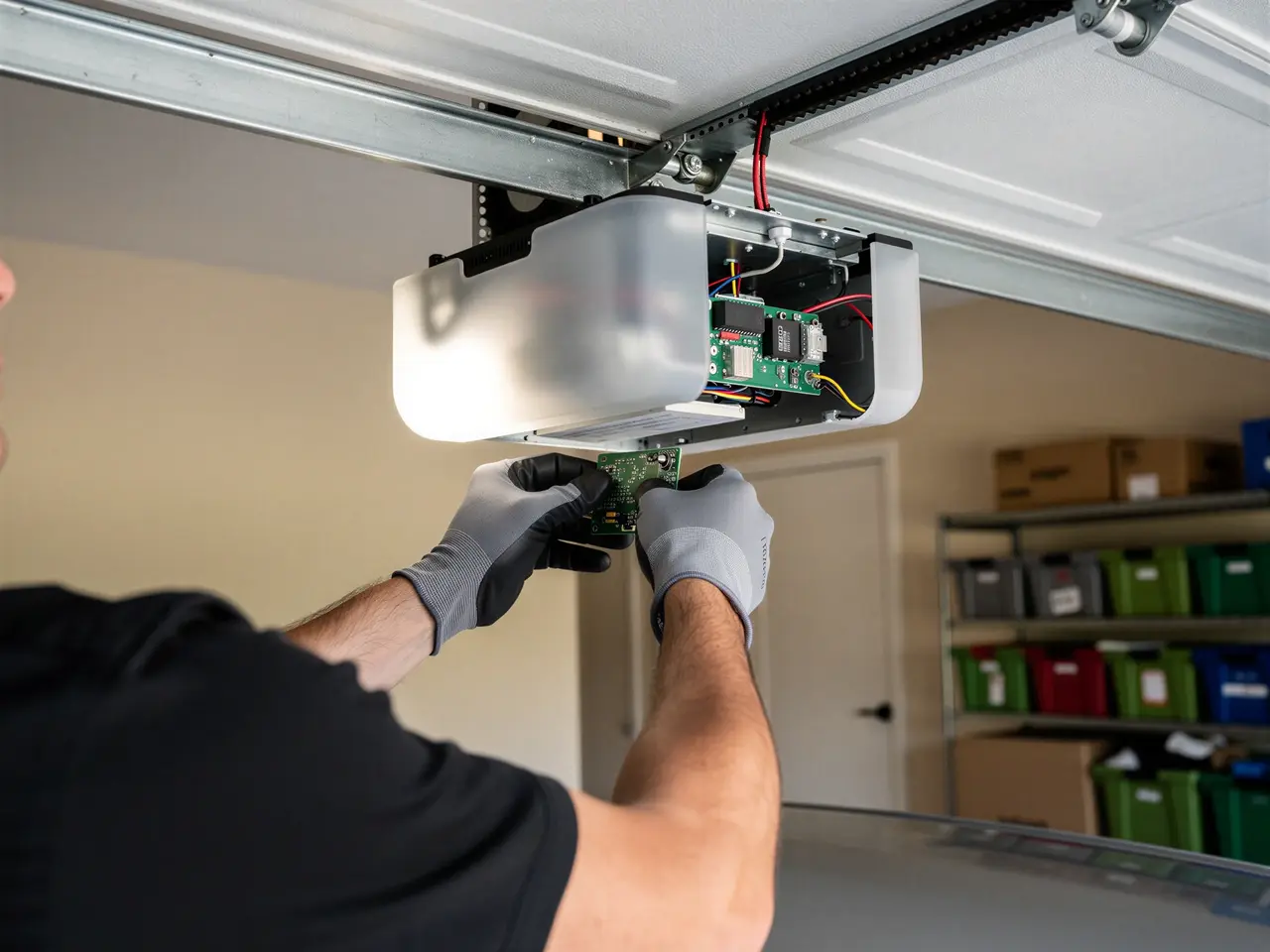
What we don't recommend you touch: the drive gear and sprocket assembly inside the motor head, or anything involving the logic board. On openers this age, the plastic gear is often already brittle, and forcing a stuck gear with a screwdriver strips it the rest of the way and can drop the door mid-cycle. If you've opened the housing and see white plastic dust in the bottom of the case, that's gear debris - stop there and get it looked at rather than reassembling and hoping.
Booking a Visit
We run out of Burlington, about six miles from Essex Junction, so there's no local branch here - the truck comes to you. That short run means we're not pricing this job as a special trip; it's a normal call on the route that also covers Winooski and Colchester on the way. When you call, it helps to know the brand name on the motor housing and roughly how old the opener is, since parts availability depends heavily on whether it's an older chain-drive unit from the original build era or a belt-drive replacement installed more recently.
For anything tied to the door itself - springs, panels, tracks - that's covered on our general opener repair page rather than repeated here. You can see our coverage for this town specifically, and the broader opener repair write-up, through the links below. We serve a wide stretch of households across this part of the county, and scheduling is first-come on the day you call, not a guaranteed same-hour slot.
How Long It Takes
The job length depends almost entirely on what's actually wrong. Swapping a logic board or a capacitor is a short, contained repair. Replacing a stripped drive gear means opening the motor housing, which adds time but is still a single visit in most cases. Where it stretches out is when the opener itself is original to a house built in the early 1980s and the whole unit - motor, gear, logic board, and safety sensors - needs replacing as a set rather than patched piece by piece.
We won't promise a number of minutes or hours here, because an honest estimate depends on what we find once the housing is open and what the chain tension and rail condition look like underneath. What we can say is that most of the delay on these older units isn't labor, it's confirming the opener is original equipment versus a prior retrofit, since that changes which gear kit and sensor set actually fit.
What Causes It Around Here
A lot of what we see on opener calls in this area traces straight back to the age of the housing stock. With a median build year around 1982, plenty of homes here still have an opener that's original or close to it - thirty-five, forty years of motor cycles on the same nylon drive gear. That gear is plastic by design, meant to strip before the motor burns out, and on units this old it's often already past its useful life even if it hasn't failed yet.
Cold is the other half of it. This region sits in a severe cold climate band, and openers mounted on unheated garage ceilings take real temperature swings - the grease in the drive assembly stiffens, chain tension shifts as metal contracts, and capacitors that were already marginal fail outright on the first hard cold snap of the season. We see a clear jump in opener calls tied to that seasonal shift, not because the units break differently here, but because so many of them are the same vintage and hitting the same wear point at once.
The Symptom
The most common call we get is a motor that hums or runs but the door doesn't move - that's almost always a stripped drive gear, and on a unit from the early 1980s build era it's often the first major failure the opener has ever had. A close second is a door that reverses immediately after closing a few inches, which usually points to a safety sensor knocked out of alignment or a travel limit that's drifted with age rather than anything wrong with the motor.
On older chain-drive units specifically, listen for a loud slap or rattle partway through the cycle - that's chain slack, and it gets worse, not better, if you leave it. Remotes that work intermittently in cold weather but fine once the garage warms up usually point to a receiver board nearing the end of its life rather than a battery problem, which is the fix most people try first and the one that rarely sticks.
Stocked Parts
The truck carries the parts that fail most often on openers from this era: nylon drive gear and sprocket kits, replacement logic boards for the more common chain-drive models, safety sensor pairs, and standard remotes and wall controls. Capacitors and travel-limit switches are stocked too, since those fail on a predictable schedule as units pass the thirty-year mark, which a good share of the openers in homes built around 1982 already have.
What isn't on the truck: belt-drive assemblies for less common or discontinued models, which sometimes need to be special-ordered once we've confirmed the exact make. If your opener turns out to be one of those, we'll tell you on-site rather than making a second trip pointless - sometimes full replacement with a current model is the more sensible call than chasing parts for a unit that's been out of production for years.
Frequently asked questions
My opener is loud and the door barely moves - is that the motor or the door itself?
If the motor runs but the door doesn't travel, that's almost always the drive gear inside the motor housing, not the door or springs. On houses built around 1982, which covers a lot of homes here, that gear has often never been replaced and is well past its expected life. Pulling the manual release to check if the door moves freely by hand is the fastest way to rule out a door-side problem first.
Do you have a shop in Essex Junction?
No - we run out of Burlington, about six miles away, and come to you. There's no local branch or drop-off counter here, so all service happens as an on-site visit at your house.
Why does my remote stop working in cold weather?
On older receiver boards, cold temperatures can cause intermittent failures that disappear once the garage warms up. This region sits in a severe cold climate band, and we see this complaint jump every year with the first hard cold snap, especially on openers original to homes from the early 1980s build era.
Is it worth repairing an opener this old, or should I just replace it?
Depends what's failed. A capacitor, sensor, or logic board swap is usually worth doing on an otherwise sound unit. But if the drive gear has stripped and the motor is the original one from a 1982-era build, we'll usually tell you straight that a full replacement costs about the same as parts-and-labor on a unit that old, and gives you a warranty the old motor can't.
More garage door services in Essex Junction
- Emergency Garage Door Repair in Essex Junction
- Garage Door Repair in Essex Junction
- Garage Door Service in Essex Junction
- Garage Door Maintenance in Essex Junction
- New Garage Door Installation in Essex Junction
- Garage Door Opener Installation in Essex Junction
- Garage Door Roller Replacement in Essex Junction
Book garage door service in Burlington
Call now or request a quote - tell us what the door is doing and where you are.